
تائف
ةديدج ةنودم
5 Key Points You Must Check When Purchasing Water Quality Sodium Ion Sensors
April 16 , 2026In water quality monitoring projects, sodium ion concentration is an important indicator, widely used in industrial wastewater discharge monitoring, drinking water source protection, agricultural nutrient solution management, aquaculture, and other fields. With the development of IoT technology, LoRaWAN-based wireless sodium ion sensors have gradually become the mainstream in the market due to their advantages of long-range communication, low power consumption, and cable-free installation. However, faced with products of different brands and models, how to select the most suitable, stable, and reliable sensor for on-site working conditions? From a practical application perspective, this article summarizes 5 purchasing suggestions.
1. Do the Measuring Range and Accuracy Match the Working Conditions?
First, clarify the sodium ion concentration range of the water to be measured. Common sensor ranges are 0.1–200 mg/L, with resolution up to 0.001 mg/L and accuracy typically around ±5% FS. For seawater or high-salinity industrial wastewater applications, confirm whether customized versions with higher ranges are available.
Also pay attention to operating conditions:
Be sure to verify that the on-site environment falls within the specifications before purchasing.
2. Electrode Type and Anti-Interference Capability
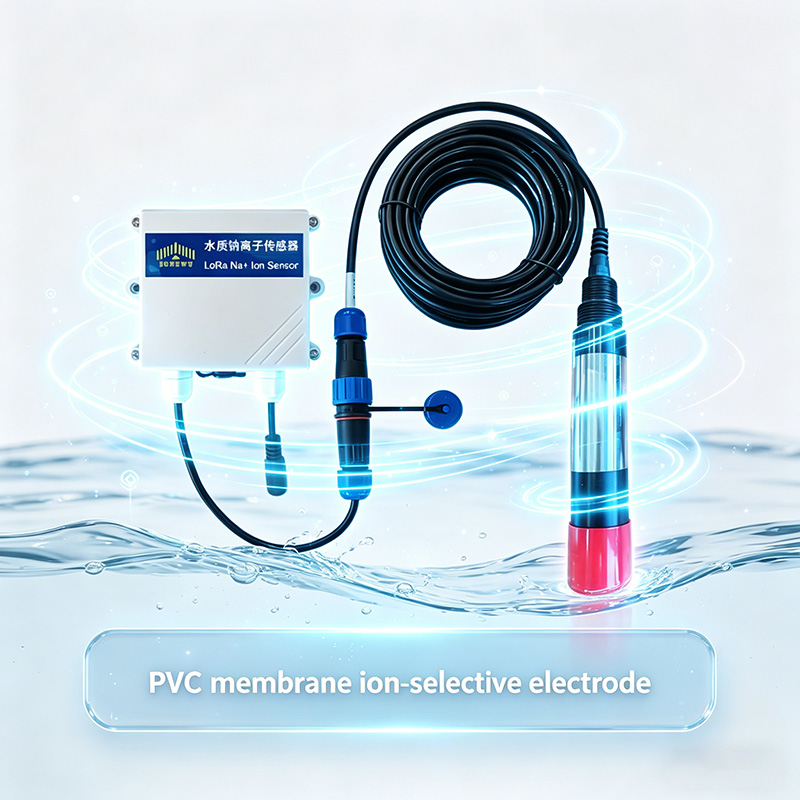
Most sodium ion sensors use PVC membrane ion-selective electrodes. When purchasing, focus on interfering ions. In actual use, sodium ion electrodes are susceptible to interference from Ag⁺, Li⁺, and H⁺. Significant measurement deviations may occur if these ions exist in the water.
In addition, electrodes are consumables with a service life of generally 6–12 months. Subsequent spare part costs and replacement convenience should also be considered. It is recommended to ask the supplier about electrode storage conditions (e.g., whether wet storage is required) and activation methods.
3. Wireless Communication Mode and Frequency Band Adaptation
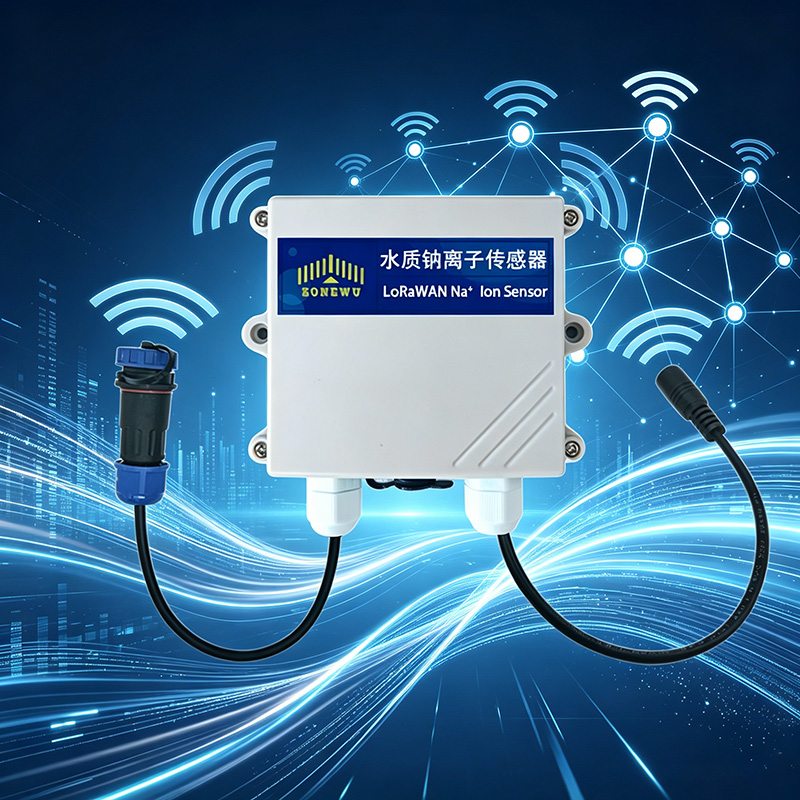
The greatest value of wireless sodium ion sensors lies in cable-free installation and remote data transmission. LoRaWAN is currently one of the most mainstream protocols. Before purchasing, confirm the following:
4. Power Supply and Installation Convenience
Is power easily available on-site? Most industrial-grade sensors use DC 10–28V power supply, rated at approximately 12V/500mA. If there is no utility power at the deployment site, an additional solar power supply system or battery-powered transmitter (with power consumption confirmed) is required.
In addition, the cable length between the sensor and the electrode is usually 5 meters by default, and longer distances can be customized. There are clear requirements for installation angle:
When purchasing, confirm whether mounting brackets are provided and the protection level (at least IP65 or higher).
5. Calibration and Maintenance Costs
Sensors are calibrated at the factory, but drift is inevitable after long-term use. Monthly calibration is generally recommended, including zero-point and slope calibration, for which standard solutions are required. New electrodes or those stored dry need to be activated in low-concentration standard solution for at least 6 hours before use.
Routine maintenance includes cleaning the sensor every 30 days and checking for damage. In addition to the unit price, calculate long-term operation and maintenance costs such as standard solutions, electrode replacement, and manual calibration.
For projects with scattered sites and limited personnel, prioritize products supporting remote calibration commands (sent via LoRa downlink), which can greatly reduce on-site operation frequency and improve efficiency.
Summary
When purchasing water quality sodium ion sensors, price should not be the only consideration. It is recommended to conduct a comprehensive evaluation from five dimensions: measuring range, electrode anti-interference performance, wireless band adaptation, power supply and installation conditions, and calibration and maintenance.
An excellent sensor should be equipped with practical functions such as automatic temperature compensation, multi-band support, and remote calibration to meet the needs of complex scenarios including industrial wastewater, surface water, drinking water, and agriculture.
If you are planning a water quality monitoring project, you may use the above points as a selection checklist to avoid passive operation and maintenance in the later stage.https://www.zonewuiot.com/water-quality-sensors_c1

فتاه : +86 18146178586
Whatsapp : +86 18146178586
ينورتكلإ ديرب : qui@zonewu.com
فيضي : 1501-3, Building F03, Phase III, Software Park, Jimei District, Xiamen City, Fujian Province, China